Wilfrid Sellars
American philosopher (1912–1989) whose "Empiricism and the Philosophy of Mind" (1956) — called by Tyler Burge "the most influential paper of the period" — demolished the "myth of the given": no cognitive state can be both epistemically independent and epistemically efficacious, so nothing can serve as the given.
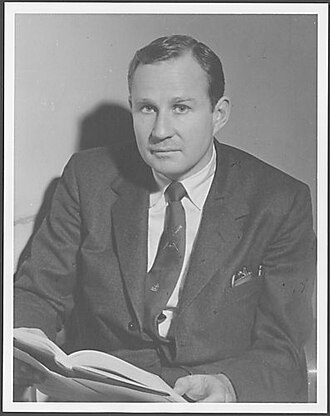
Biographical Record
- Lived
- 1912–1989
- Tradition
- American
- Wikidata
- Q712462 (dates source)
- Portrait Credit
- S. Edgerton · Public domain
Life & Context
- Born 20 May 1912 in Ann Arbor, Michigan; died 2 July 1989.
- Son of Roy Wood Sellars, the critical realist — the son's systematic ambitions are the family business continued.
- Pittsburgh became his department and his school: the Pittsburgh Steelers of philosophy, as the joke ran.
Key Contributions
- The myth of the given: EPM's reconstructed argument — epistemic independence and epistemic efficacy cannot coexist in one state; foundationalism's building block is a myth.
- Manifest and scientific images: "Philosophy and the Scientific Image of Man" distinguishes the two idealized frameworks — the scientific image "presents itself as a rival image" — and asks for a "synoptic vision" uniting scientific description with the language of community and individual intentions.
- The space of reasons: EPM §36 — characterizing a state as knowing places it "in the logical space of reasons, of justifying and being able to justify what one says"; the passage central to Brandom and McDowell.
- Philosophy's aim: understanding "how things in the broadest possible sense of the term hang together in the broadest possible sense of the term".
Major Works
- "Empiricism and the Philosophy of Mind" (1956/1997).
- "Philosophy and the Scientific Image of Man" (1962).
- Science and Metaphysics (1968).
Influence & Reception
- Pittsburgh postwar philosophy — Brandom, McDowell — is Sellarsian; the "space of reasons" is its currency.
- With Quine he forms the dual demolition of logical empiricism: the given and the analytic both gone.
- Scientific realism as the final arbiter, with the manifest image's persons never reduced away — his hard balance, still unsteady and still fought over.
Connections
- Quine — the co-demolisher.
- Knowledge — in the space of reasons.
- Naturalism — with the normative preserved.
- Logical positivism — the target both shared.
- Meaning — as use, in a linguistic knot.
- Philosophy of science — the rival image that wins.
Sources
- Stanford Encyclopedia of Philosophy: Wilfrid Sellars — the myth of the given, manifest and scientific images, the space of reasons.