William of Ockham
English Franciscan philosopher (c. 1287–1347) whose name is attached to the razor about not multiplying entities beyond necessity — a slogan that, as his entry notes, never appears in his texts in that form, though the sentiment is his. He held realist theories of universals to be incoherent, and ended his life excommunicated in Munich, having concluded the Pope himself was a heretic.
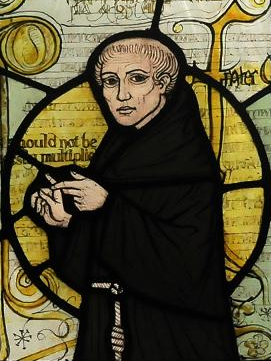
Biographical Record
Life & Context
- Born late 1287 or early 1288 in Ockham, Surrey; died 9/10 April 1347 in Munich.
- Summoned to Avignon (1324–28) to answer a heresy inquiry, he instead examined Pope John XXII's statements on Apostolic poverty for Michael of Cesena — and concluded the Pope was "no pope at all".
- Fled Avignon on 26 May 1328, excommunicated 6 June, and lived under Emperor Ludwig of Bavaria's protection for the rest of his life.
Key Contributions
- The razor: the fullest version permits less parsimonious claims only when justified by reason, experience, or infallible religious authority — applied to reject "species" in cognition and to reduce Aristotle's ten categories.
- Nominalism: realist theories of universals are incoherent, not merely unparsimonious — only universal concepts and terms exist; there is no universal felinity, only individual cats. He first held a fictum-theory, later the intellectio-theory: a universal concept is "the act of thinking about several objects at once".
- Political philosophy: in exile he wrote exclusively on politics — the Work of Ninety Days, the Dialogue, Eight Questions on the Power of the Pope — arguing that no individual or church body, including the pope, is infallible, and distinguishing natural, inalienable rights from rights "of the forum".
- Church and state: spiritual and temporal powers are independent, with intervention allowed only exceptionally — such as deposing a heretical pope.
Major Works
- Summa of Logic (c. 1323) — the nominalist system.
- Work of Ninety Days (1332–34) — against John XXII on poverty.
- Dialogue (c. 1334–46, unfinished) — the political summa.
Influence & Reception
- The via moderna he led reshaped medieval scholasticism; Duns Scotus was the target he sharpened against, as Aquinas was the system he dismantled.
- His insistence on parsimony and individual substances anticipates early modern science and empiricism.
- His rights theory is a landmark in the history of justice and natural rights.
Connections
- Universals — the problem he retired.
- Knowledge — intuitive cognition against species.
- Faith and reason — separated on principle.
- Logic — the razor's home field.
- Duns Scotus — the older rival.
Sources
- Stanford Encyclopedia of Philosophy: William of Ockham — the razor's real formulation, nominalism, the Avignon break, the political writings.