Thomas Hobbes
English philosopher (1588–1679) whose Leviathan (1651) built politics from the ground up: in the "condition of mere nature", with no common power, private judgment becomes a war of all against all, and life is "solitary, poore, nasty, brutish, and short". The exit is the social contract.
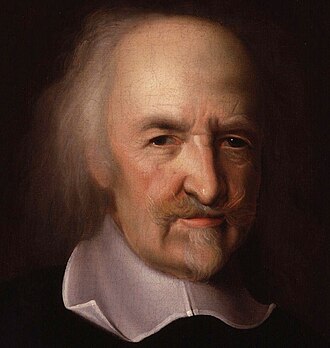
Biographical Record
- Lived
- 1588–1679
- Tradition
- English
- Wikidata
- Q37621 (dates source)
- Portrait Credit
- John Michael Wright · Public domain
Life & Context
- Born 5 April 1588; died 4 December 1679 — his life spanned the civil wars that gave his politics their edge.
- Left England late in 1640 for Paris exile on the royalist side, "might also have had reason to fear punishment because of his defence of absolute sovereignty", and stayed until 1651 — where he wrote Leviathan.
- A Latin edition followed in 1668, with changes on controversial topics like the Trinity and God's nature.
- His Behemoth (late 1660s, published posthumously) is a history of the civil wars he theorized.
Key Contributions
- The state of nature: perfectly private judgment with no recognized authority becomes a war of "all against all" — with "no place for industry", no arts, no letters (Leviathan XIII).
- The right of nature: each person's liberty right to do whatever one sincerely judges needful for survival — in practice a right "to all things", since almost anything might seem necessary.
- Sovereignty by institution and acquisition: people covenant either to obey a common authority or to accept a conqueror's protection; subjects "own and authorize" the sovereign's actions, and obligation ends when protection ceases — legitimacy tracks effectiveness.
- Materialism: by Leviathan and De Corpore (1655), human beings including their minds are entirely material; "incorporeal substance" is insignificant speech, and God a "corporeal spirit" — the century's most radical ontology.
- Morality as natural law: "the true doctrine of the Lawes of Nature is the true Morall philosophie"; while the state lasts, private appetite is the only measure of good and evil.
Major Works
- Leviathan (1651) — from mind and language to the sovereign.
- De Cive (1642) — the political theory, first out.
- De Corpore (1655) — the materialist system.
- Behemoth — the civil wars, historized.
Influence & Reception
- The contract tradition's founding negative: Locke and Rousseau wrote their cheerier states of nature against his.
- He objected to Descartes's Meditations in print — the materialist thorn in the rationalist side.
- Per Aubrey, he fell for geometry at forty through Euclid's Elements — then spent decades failing to square the circle against Wallis and Ward.
Connections
- Sovereignty — his word for the common power.
- War and fear — the state of nature's weather.
- Power — the currency his politics counts in.
- Social contract — the exit he engineered.
- Natural law — the doctrine he re-founded as morality.
- The seventeenth century — his civil-war laboratory.
Sources
- Stanford Encyclopedia of Philosophy: Hobbes's Moral and Political Philosophy — the state of nature, right of nature, sovereignty by institution and acquisition.
- Stanford Encyclopedia of Philosophy: Thomas Hobbes — the life, materialism, Leviathan's editions, the geometry.