Charles Sanders Peirce
American philosopher (1839–1914), the founder of pragmatism — a name he later changed to "pragmaticism" (c. 1905), he joked, because it was ugly enough to be safe from kidnappers — and of a triadic theory of the sign whose interpretants generate interpretants without end. "Do not block the way of inquiry!" was his first principle of reason.
Biographical Record
- Lived
- 1839–1914
- Tradition
- American
- Wikidata
- Q187520 (dates source)
- Portrait Credit
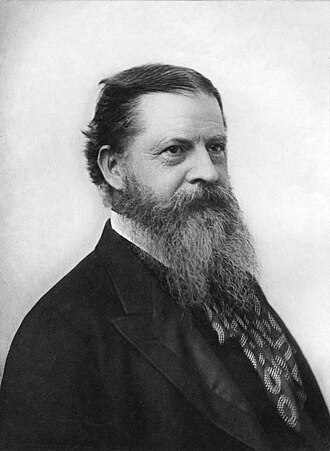
- Napoleon Sarony · Public domain
Life & Context
- Born 10 September 1839 in Cambridge, Massachusetts; died 19 April 1914 in Milford, Pennsylvania.
- Trained as a scientist — decades with the US Coast Survey, work in metrology and mathematical logic — and the practice of science is the spine of his philosophy.
- Employment in academia eluded him after Johns Hopkins; much of the vast corpus was written in isolation at Milford, unpublished until the twentieth century's edition.
Key Contributions
- The pragmatic maxim: from "How to Make Our Ideas Clear" (1878) — a conception's meaning consists in its totality of possible practical and experiential consequences.
- Semeiotic: his theory of signs — "semeiotic", distinct from Saussure-derived semiotics — treats the sign relation as triadic: representamen, object, interpretant; three trichotomies (icon, index, symbol) yield, he concluded, only ten genuinely possible sign kinds of twenty-seven.
- Fallibilism: the anti-Cartesian, anti-foundationalist principle — inquiry is inherently fallible, and at no point can we know how far we are from the limit toward which science converges.
- Abduction: distinguished from deduction and induction around 1865 — the "educated guess" that explains surprising phenomena, integrated with the others as phases of scientific method: hypothesis, deduction of testable consequences, inductive testing, guided by the economy of research.
Major Works
- "The Fixation of Belief" and "How to Make Our Ideas Clear" (1877–78) — the pragmatist founding papers.
- "On a New List of Categories" (1867) — the categories.
- The Lowell Lectures and the unfinished system of the 1890s–1900s.
Influence & Reception
- Pragmatism is his creation, developed differently by James and Dewey — the renaming was his protest at what it became.
- His semeiotic underwrites modern sign theory and much of philosophy of language; his logic anticipated logic's quantifier era.
- Contemporary scientific realism and inference-to-the-best-explanation debates quote abduction as the origin story.
Connections
- Sign — the triad at the center.
- Meaning — practical consequences.
- Truth — the final opinion toward which inquiry converges.
- Belief — the fixation, and doubt as its irritation.
- James and Dewey — the movement he began and disowned.
Sources
- Stanford Encyclopedia of Philosophy: Charles Sanders Peirce — the pragmatic maxim, semeiotic, fallibilism, abduction.