Epictetus
Greek Stoic philosopher (born in the 50s CE, died around 135) who spent part of his life as the slave of Epaphroditus, an administrator in Nero's court — and taught, once free, that volition is "by nature unimpeded": freedom is inalienable because it lives in the one thing no master can touch.
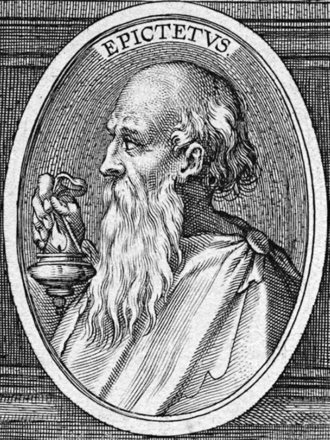
Biographical Record
- Lived
- 50–135
- Tradition
- Greek
- Wikidata
- Q183144 (dates source)
- Portrait Credit
- Theodoor Galle · Public domain
Life & Context
- Born in Hierapolis, a Greek city in Asia Minor; slave of Epaphroditus, then freedman; taught at Nicopolis in northwest Greece.
- Taught orally; his student Arrian of Nicomedia recorded the Discourses in koinē Greek — originally eight or more books, four survive — and abridged them into the Encheiridion, the Manual.
Key Contributions
- The dichotomy of control: prohairesis — volition, the capacity of choice — is "by nature unimpeded"; body, possessions and reputation are externals outside the sphere of volition.
- Virtue as the only good: virtue is "a certain disposition of one's volition" (1.8.16) — the sole true good, since everything else can be taken.
- The therapeutic method: philosophy as training — desire and aversion re-ordered, impressions examined before assent; the classroom a hospital of the soul.
- Practice over text: the Encheiridion's compression made him portable — the entry cautions it is of limited independent value next to the Discourses, and sometimes misleading.
Major Works
- The Discourses (four books surviving of eight or more, via Arrian).
- The Encheiridion — the Manual, Stoicism's pocket gospel.
- Fragments preserved by Stobaeus and others.
Influence & Reception
- Origen noted Epictetus's popularity rivalled Plato's; Simplicius wrote a Neoplatonic commentary on the Encheiridion; and Marcus Aurelius — no page yet for the emperor — regarded himself as his follower after reading the works.
- After Poliziano's 1497 Latin translation he became ubiquitous in Europe — an influence reaching Descartes and, by the entry's happy example, Tom Wolfe's 1998 novel A Man in Full.
- Modern Stoicism revivals — from cognitive therapy to the military — quote him first.
Connections
- Stoicism — the school's slave-turned-teacher.
- Seneca — the other Roman Stoic voice.
- Freedom — inalienable, internal.
- Virtue — the disposition of volition.
- Self — the prohairesis that is truly ours.
- Emotion — trained, not suppressed; the passions re-educated.
Sources
- Stanford Encyclopedia of Philosophy: Epictetus — the slavery, prohairesis and the dichotomy, the Discourses and Encheiridion, the reception.