Atra-Hasis Epic
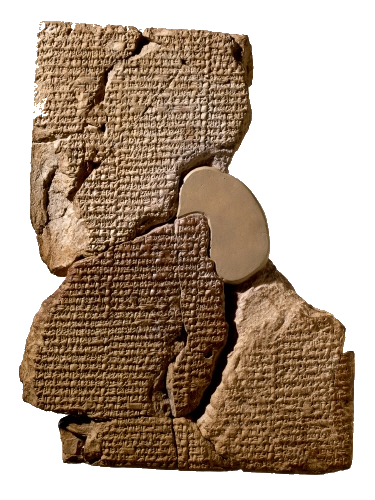
Eighteenth-century BCE Old Babylonian epic titled from its opening words Inūma ilū awīlum ("When the gods like men"), preserved across three large cuneiform tablets copied by the Junior Scribe Ipiq-Aya (often read Ku-Aya) under King Ammi-ṣaduqa of Babylon. It narrates the labor strike of the lesser Igigi gods, the creation of humankind from clay and divine blood by Enki (Ea) and the mother goddess Ninhursag (Mami / Belet-Ili), and the catastrophic Great Flood decreed by Enlil when human clamor disturbed his sleep.
Core Themes
- Rebellion of the Igigi after forty years of digging the Tigris and Euphrates beds, prompting the Assembly of the Gods to create mortals to bear the gods' toil (Purpose of Humans).
- Fashioning of seven male and seven female pairs from clay kneaded with the flesh and blood of the slain god Ilawela (We-ila) so humans possess both mortal labor capacity and a ghost (etemmum).
- Successive population crises answered by plague (Namtar), drought (Adad), famine, and the seven-day flood survived by Atra-Hasis ("Exceedingly Wise") in a reed boat built on Enki's covert instructions.
Primary Text & Editions
- Untranslated Akkadian (cuneiform & transliteration): electronic Babylonian Literature (eBL) — Flood & Creation Corpus (LMU Munich)
- English translation & parallel text: eBL Akkadian–English Parallel Edition; Oracc CAMS/GKAB Corpus
- Primary tablet witness (CDLI): British Museum Tablet I (BM 78941 / ME 78941, Sippar) on CDLI
- Critical edition: Lambert, W. G., and A. R. Millard. 1969. Atra-ḫasīs: The Babylonian Story of the Flood. Oxford: Clarendon Press; Foster, B. R. 2005. Before the Muses, 3rd ed., pp. 227–280.
Related Concepts & Sources
Enki (creator and advisor of Atra-Hasis), Enlil (initiator of the flood), Ninhursag (mother goddess who shapes humanity), Creation of Humanity (mythic motif), Epic of Gilgamesh (Tablet XI parallel)